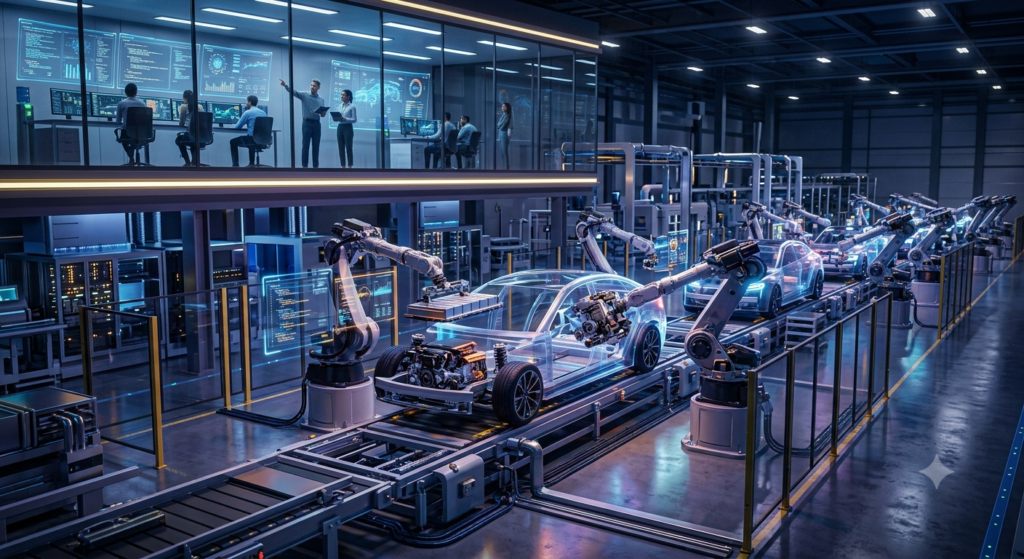

Artificial Intelligence (AI) is transforming the manufacturing industry by making factories smarter, safer, and more productive. Modern manufacturers use AI-powered systems to automate production lines, monitor equipment, improve quality control, and reduce operational costs. As industries move toward smart manufacturing, AI has become an essential technology for increasing efficiency and staying competitive.
From automotive production to electronics and consumer goods, AI is changing how products are designed, built, and delivered.
What Is AI in Manufacturing?
AI in manufacturing refers to the use of intelligent software, machine learning, and robotics to improve industrial production. These systems analyze data collected from machines, identify potential issues, optimize production schedules, and automate repetitive tasks with high precision.
Instead of replacing human workers, AI supports engineers and technicians by handling complex calculations and repetitive operations.
Benefits of AI in Manufacturing
Artificial Intelligence offers several important benefits for manufacturers.
These include:
- Increased production efficiency
- Reduced equipment downtime
- Higher product quality
- Lower operating costs
- Faster production cycles
- Improved workplace safety
- Better inventory management
- Predictive maintenance
These advantages help companies produce more while reducing waste and improving profitability.
Common Applications of AI in Manufacturing
Predictive Maintenance
AI monitors factory equipment in real time and predicts mechanical failures before they happen, reducing costly downtime.
Quality Inspection
Computer vision systems inspect products for defects with greater accuracy than traditional manual inspections.
Industrial Robotics
AI-powered robots perform repetitive assembly tasks quickly, accurately, and safely.
Supply Chain Optimization
AI forecasts product demand, manages inventory, and improves logistics planning.
Production Planning
Manufacturers use AI to optimize factory schedules and maximize equipment utilization.
How AI Improves Manufacturing
Artificial Intelligence allows factories to make faster decisions based on real-time production data. Managers receive instant insights into machine performance, product quality, and operational efficiency, allowing them to respond quickly to changing conditions.
This results in higher productivity and lower production costs.
Challenges of AI in Manufacturing
Despite its many benefits, manufacturers also face several challenges.
These include:
- High implementation costs
- Employee training requirements
- Cybersecurity risks
- Data integration challenges
- Equipment compatibility
- Ongoing system maintenance
Successful AI adoption requires careful planning and skilled professionals.
The Future of Smart Manufacturing
Future factories will rely even more on AI, robotics, and automation. Digital twins, autonomous production systems, intelligent quality control, and fully connected smart factories will continue improving manufacturing efficiency around the world.
Companies investing in AI today are preparing for a future driven by intelligent automation and advanced industrial technologies.
Frequently Asked Questions
Can AI replace factory workers?
AI automates repetitive tasks, but skilled workers remain essential for supervision, maintenance, and decision-making.
Is AI expensive for manufacturers?
Initial implementation may require investment, but long-term savings often outweigh the costs through increased efficiency and reduced downtime.
Which industries benefit most from AI manufacturing?
Automotive, electronics, pharmaceuticals, aerospace, food processing, and consumer goods manufacturing are among the industries benefiting the most.
Final Thoughts
Artificial Intelligence is transforming manufacturing by improving productivity, reducing costs, and enhancing product quality. As smart factories become more common, AI will continue driving innovation and helping manufacturers meet the growing demands of the global economy.